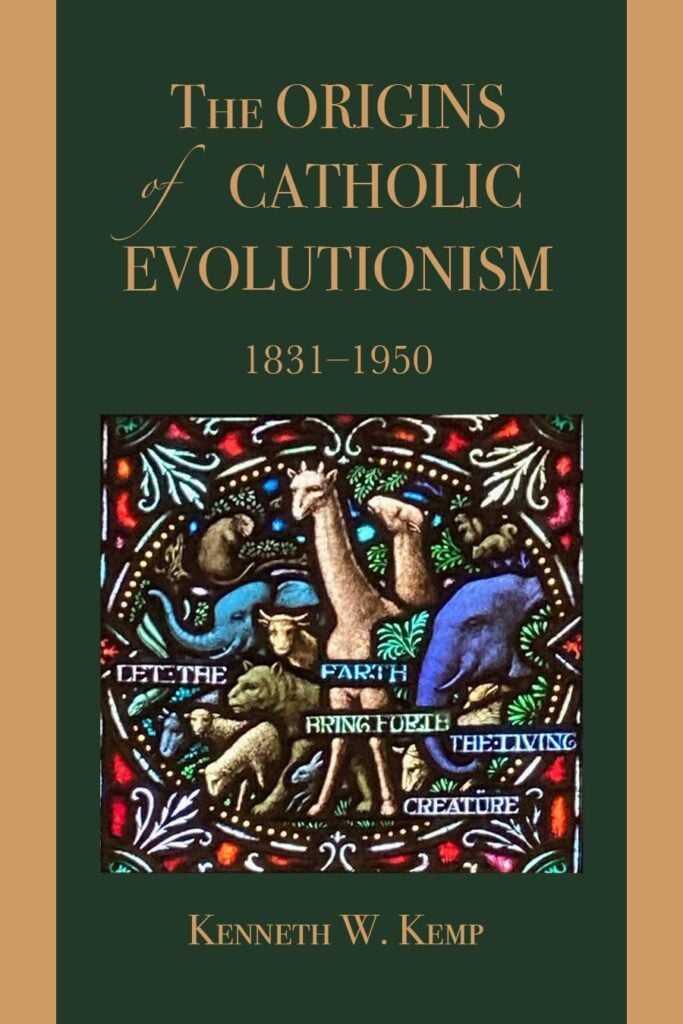
The Origins of Catholic Evolutionism, 1831–1950
by kenneth w. kemp
the catholic university of america, 540 pages, $85
Darwin and Doctrine:
The Compatibility of Evolution and Catholicism
by daniel kuebler
word on fire, 304 pages, $29.95
The Catholic Church never condemned the theory of evolution nor came close to doing so. One might have expected otherwise: Many of the factors that had led to the Galileo fiasco two centuries earlier were present again. Darwin, like Galileo, was proposing a radical theory that struck many people as absurd—and that seemed contrary to the “plain meaning” of certain scriptural verses as they had generally been construed. Both theories were at first controversial even among scientists and faced weighty scientific objections, both observational and theoretical, which could not be resolved until decades later. Both theories contradicted aspects of the Aristotelianism that prevailed among Catholic theologians. Finally, both Galileo and Darwin promulgated their theories at times when the Church faced powerful challenges to her credibility and authority, as a result of which her doctrinal defense mechanisms were on high alert. Even if the Vatican’s condemnation of Galileo did not formally and irrevocably commit the Church doctrinally, it put the Church, for a time, on the wrong side of a scientific issue. The same could easily have happened with On the Origin of Species.
Indeed, in some ways, the circumstances facing the theory of evolution were even less auspicious than those Galileo contended with. Galileo’s offending ideas, after all, concerned astronomy, which Cardinal Bellarmine admitted at the time pertained to the faith only “incidentally,” whereas the theory of evolution, as applied to human beings, concerned matters of the highest theological importance, such as the nature of man and the doctrine of original sin. And whereas in Galileo’s day no one was using heliocentrism to attack Christianity and virtually all scientists were Christians, by the late nineteenth century religious skepticism and scientific materialism had gained many adherents, and evolution was being used as a cudgel against religion. As a result, many Christians, both Catholic and Protestant, were disposed to be deeply suspicious of the new ideas and the people who advocated them.